If the reformer is the heart of Pilates equipment work, then the Short Box Series is its spine—literally and figuratively. These fundamental yet deeply challenging exercises are designed to strengthen the core, increase spinal mobility, and refine postural alignment. Practiced on the reformer using a supportive box and foot strap, the Short Box Series brings a grounded intensity that demands both control and range.
While it’s often taught at the beginner-to-intermediate level, the Short Box Series remains a staple in advanced sessions due to its versatility and effectiveness. Whether you’re looking to deepen your connection to your center, improve spinal articulation, or fine-tune your posture, this series delivers.
In this article, we’ll break down each element of the Short Box Series, explore setup and alignment tips, highlight its core benefits, and show you how it integrates into a broader Pilates practice.
 What Is the Short Box Series?
The Short Box Series is a group of reformer exercises performed while sitting on a box placed across the reformer carriage, typically with the foot strap secured over the feet. The box offers height and support, allowing the spine to move freely without contact with the shoulder blocks or carriage base.
Common Exercises in the Series:
-
Round Back
-
Flat Back
-
Side to Side
-
Twist
-
Tree Stretch (optional or added as a progression)
Each movement emphasizes spinal alignment, abdominal control, and functional range of motion—all key principles in Pilates.
These exercises are typically included in Reformer Pilates Videos that focus on posture correction, core strength, and spinal articulation.
Equipment & Setup
-
Box: Placed horizontally (across the width) on top of the reformer carriage
-
Foot strap: Positioned at the base of the reformer and wrapped over the arches of the feet
-
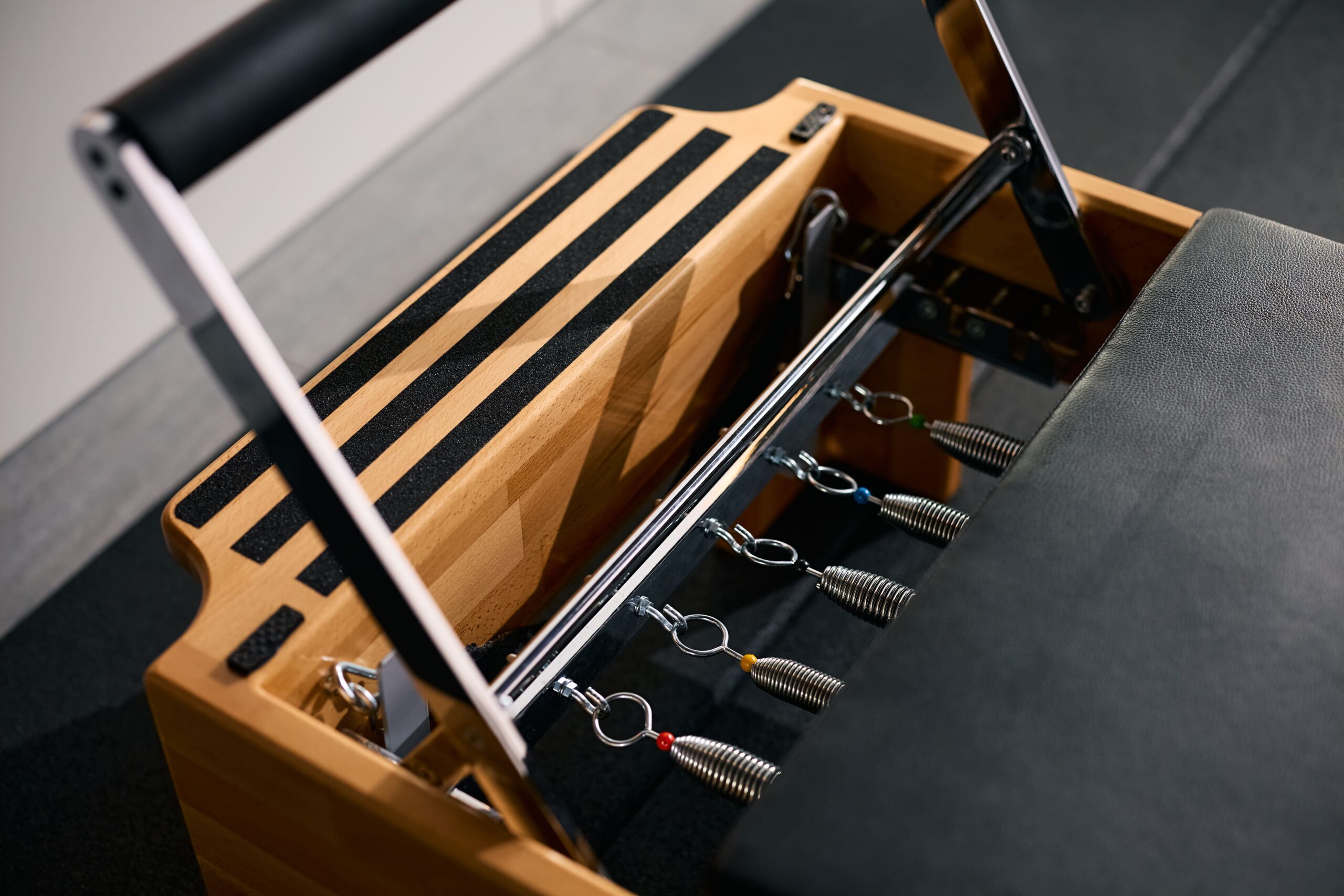
Springs: Usually all springs attached to stabilize the carriage during the exercises
-
Pole or Dowel (optional): Used in Flat Back and Twist for alignment and reach
Correct setup is essential for safety and effectiveness. The hips should be near the front edge of the box with the feet fully secured under the strap. Spine remains upright or rounded based on the exercise variation.
This grounded yet challenging setup teaches the practitioner to initiate movement from the core rather than relying on momentum or compensation.
Short Box Series Breakdown
🔹 Round Back
Purpose: Spinal articulation, abdominal control, and breath awareness
-
Sit tall with hands wrapped around the waist or across the chest
-
Inhale to prepare
-
Exhale to round the spine from the pelvis, rolling back until the arms are extended and the abdominals fully engaged
-
Inhale at the bottom
-
Exhale to return to seated
Focus: Initiating the curl from the pelvis, maintaining even flexion throughout the spine, avoiding tension in the neck or shoulders
Often taught early in Beginner Pilates Videos, this move builds awareness of how to control spinal flexion through the deep abdominals.
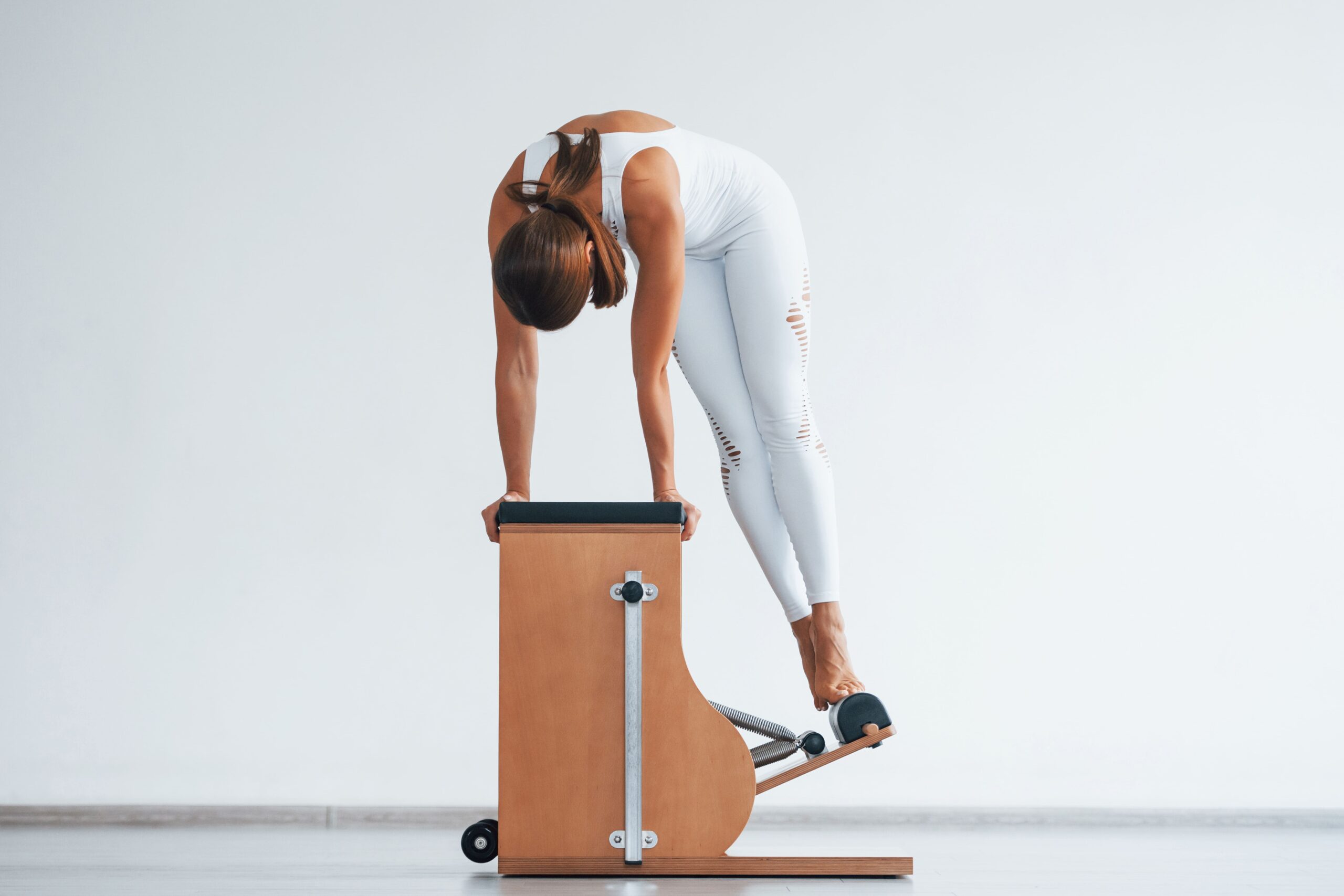 🔹 Flat Back
Purpose: Core control, neutral spine stability, and postural strength
-
Sit upright, legs extended and secure under the strap
-
Arms can be extended forward or holding a dowel overhead
-
Inhale to lift tall
-
Exhale and hinge back from the hips, maintaining a long, neutral spine
-
Inhale to pause
-
Exhale to return upright with precision
Key Cue: “Lean like a board,” not a slouch. Flat Back strengthens the erector spinae, hip flexors, and transverse abdominis.
🔹 Side to Side
Purpose: Lateral flexion and oblique activation
-
Sit tall with hands behind head or holding a dowel overhead
-
Inhale to prepare
-
Exhale to side bend, reaching over one hip while staying square in the hips
-
Inhale to center
-
Exhale to repeat on the other side
Avoid collapsing or twisting. The motion should be purely lateral, emphasizing side body lengthening and control.
🔹 Twist
Purpose: Spinal rotation, oblique strengthening, and balance
-
Begin in the Flat Back position with a dowel or arms extended
-
Inhale to lift
-
Exhale to rotate the torso to one side
-
Optional: Add a hinge back while holding the rotation
-
Inhale to return
The Twist demands core dissociation—moving the spine independently of the pelvis—which enhances functional rotation for real-life movement.
This variation also appears in Pilates Fusion Workouts, often blended with leg movements or upper-body work to increase challenge.
[Consider referencing the Pilates Fusion Workouts section here, as twist combinations are common in those classes] (image)
🔹 Tree Stretch
Purpose: Hamstring flexibility, spinal articulation, and deep core work
-
Sit tall and lift one leg toward the ceiling, holding behind the thigh or calf
-
Inhale to lengthen through the spine
-
Exhale to roll back, articulating the spine one bone at a time while keeping the leg extended
-
Inhale to walk the hands down the leg
-
Exhale to roll back up, stacking the spine as you climb up the leg
Tree adds a flowing, expressive element to the Short Box Series and integrates hamstring mobility with core stability.
[This stretch closely connects to topics in the Hamstring Stretch, Spinal Articulation article] (image)
Benefits of the Short Box Series
-
Deep core engagement: Especially in rotational and flexion work
-
Spinal mobility: Encourages full range through flexion, extension, lateral, and rotation
-
Improved posture: Teaches control and upright alignment
-
Hip stability: Securing the legs provides feedback and promotes alignment
-
Functional strength: Builds body awareness and coordination
Common Mistakes and How to Fix Them
-
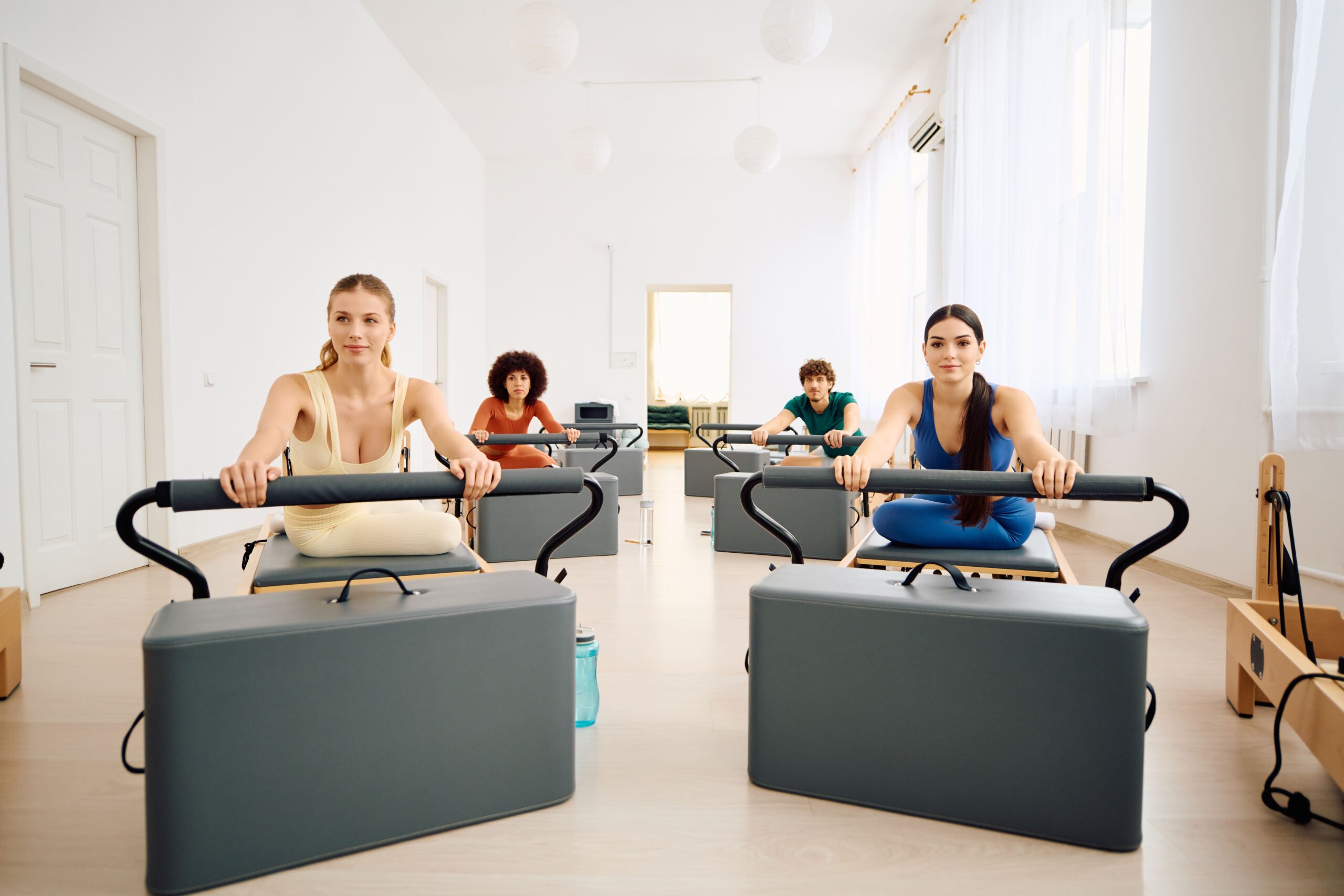 Rounding the shoulders in Flat Back or Twist → Pull the shoulder blades down and maintain space between ears and shoulders
 -
Gripping the hip flexors → Soften the knees slightly and engage the lower abdominals more
-
Losing control on return → Slow the movement down; focus on breath-led transitions
-
Twisting from the arms instead of the waist → Initiate rotation from the ribcage and obliques, not from the shoulders
Using a mirror or camera to observe form during these exercises can be incredibly helpful for self-correction.
Integrating the Short Box into Your Routine
While traditionally taught mid-way through a reformer class, the Short Box Series can be used:
-
As a core-focused block in any reformer workout
-
To improve spinal articulation at the beginning or end of a session
-
As a mobility tool for athletes, runners, or office workers
-
In Pilates for Special Populations, particularly when focusing on posture or spinal health
It complements both mat-based spinal work and Reformer sequences that involve the Long Stretch Series, Elephant, and Plank Series. Make sure to check out a combination of Short Box and Reformer: Pilates Reformer – Short Box Series
FAQs
Can I do the Short Box Series on a mat instead of a reformer?
You can simulate some movements (like Tree or Twist), but the foot strap and box support provided by the reformer create the stability needed for full expression.
What spring setting should I use for the Short Box Series?
Use all springs or the heaviest spring setting to stabilize the carriage, since the goal is movement through the spine, not the reformer.
Do I need to use a pole or dowel?
It’s optional. A dowel can help with alignment, especially in Flat Back and Twist. It encourages shoulder stability and spatial awareness.
Why does my back hurt during Round Back?
You may be over-rounding or initiating the movement from the neck or mid-back. Focus on curling from the pelvis and using the abdominals for support.
Is the Short Box Series only for intermediate or advanced students?
No. With proper guidance, beginners can learn these movements using smaller ranges and extra support (e.g., sitting on a pad, using a shorter lever).
The Short Box Series might not look flashy, but it’s where form becomes refined and strength becomes centered. These seemingly simple exercises are incredibly potent, unlocking deeper levels of spinal awareness, core control, and postural alignment. Whether practiced on their own or integrated into a flowing reformer session, they’re a key chapter in the language of Pilates.